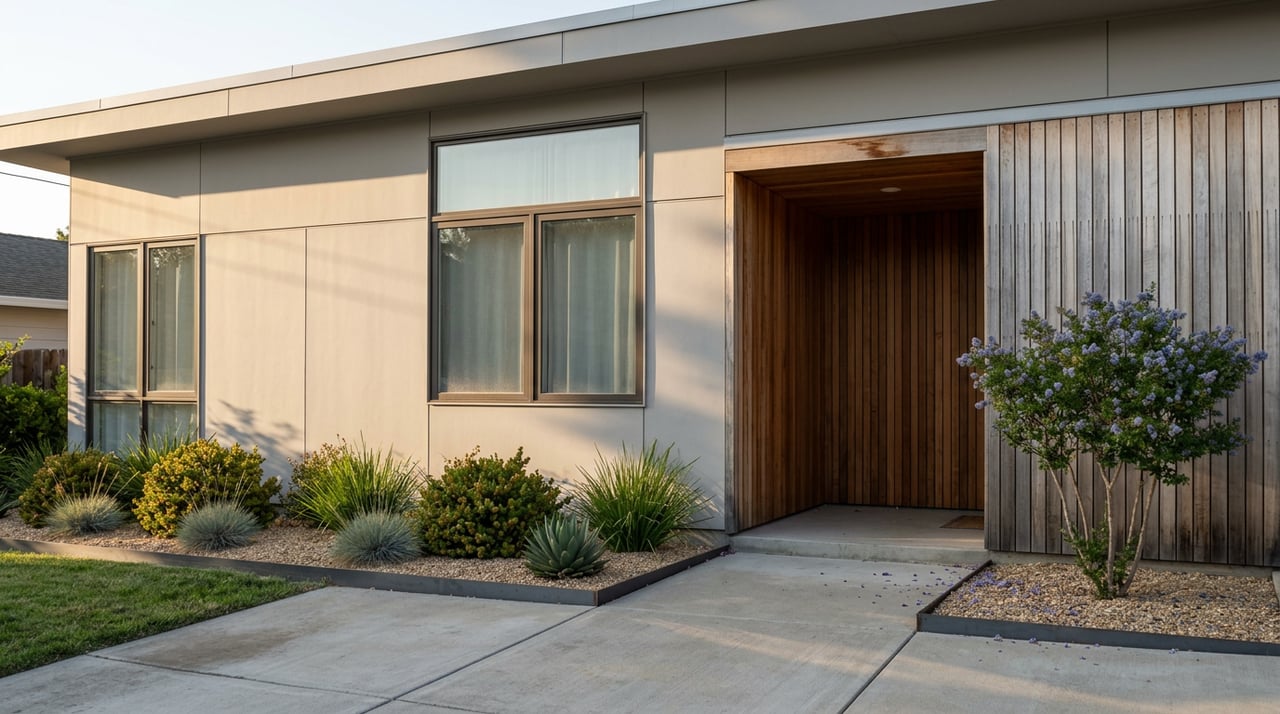
Why Hercules's Median Home Price Keeps Contradicting Itself
August 20, 2026
August 20, 2026
Pull up different sites for Hercules home prices and you'll get different answers. One says the market cooled. Another says it's up double digits. A third splits the difference. None of them are lying. They're each telling the truth about a market too small to have just one truth.
If you've been comparing Hercules to other San Pablo Bay towns before making an offer, this matters more than it sounds. The "median" you saw on your first search might be describing a completely different pocket of Hercules than the one your agent is pulling comps from.
Start with what actually happened this year. In March 2026, one tracking site logged a median sale price of $530,000 in Hercules, based on just 10 closed sales, with homes taking a median of 24 days to sell. A month later, a different site's April numbers showed 51 homes selling at a median of $600,000, averaging 40 days on market. By June, that same site's listing-side data, what sellers were asking rather than what buyers paid, put the median at $549,000.
Meanwhile a third site's March figure for the city put the median sale price at $749,499. Narrow that same site's search to its specific "Hercules" neighborhood boundary and the January number jumps to $812,500, based on two active listings.
Then there's the number that should worry you most if you're relying on any single tool: one major valuation site's own automated home-value index showed two different current typical values on two of its own pages this year, $798,466 on one page and $962,252 on another, moving in opposite directions year over year. Same company, same underlying methodology, different answer depending on which page you land on.
Zoom out to a full year of closed sales and yet another source puts the median at $883,000, with individual home prices ranging from $675,000 to $1.35 million. That range alone tells you something these single-number medians can't: a $675,000 close and a $1.35 million close sitting in the same "median" calculation are not describing comparable homes, and averaging them tells you almost nothing about what your specific budget will actually buy.
The reason these numbers disagree isn't sloppy data. It's arithmetic. Hercules is a small city, roughly 24,000 people, and its monthly home sales volume runs somewhere between 10 and 51 transactions depending on the month and the source counting them. When your sample size is that thin, one $1.3 million waterfront closing or one $500,000 estate sale can swing a "median" by tens of thousands of dollars, all by itself, with nothing about the broader market actually changing.
Compare that to a city selling 500 homes a month. One unusual sale barely moves the needle. In Hercules, one unusual sale is often a meaningful fraction of the entire month's data.
This is also why sold-price medians and list-price medians can diverge inside the same source in the same season. Sellers set an asking price based on what they hope the market will bear. Buyers close at what the market actually pays. In a market this thin, those two numbers can drift apart for months before they reconcile.
The volume problem explains why the numbers bounce. It doesn't explain why they land in such different neighborhoods of the price spectrum. That part comes down to geography, and Hercules has at least three distinct pockets that rarely trade in the same month.
Victoria by the Bay and the neighboring Bayside community sit closest to the water. These are larger homes, 2,053 to 3,983 square feet, built between 2002 and 2006 with Victorian-style architectural details and corner lots near the San Pablo Bay shoreline trails. Listings specifically tagged as Victorian in this pocket carried a median around $723,000, and that's before factoring in the larger, newer homes that push well past $1 million.
A different, older phase of that same waterfront area tells a different price story. Streets in Hercules by the Bay were built mostly in the 1980s, a generation before the Victorian-style Bayside streets went in. One representative listing here was a 1,763 square foot, four-bedroom home on a 4,275 square foot lot, marketed specifically toward first-time buyers looking to plant roots in an established neighborhood. Same shoreline, same city, a meaningfully lower price tier simply because the houses went up twenty years earlier.
Then there's Central Hercules, which carries roughly double the flood-risk exposure of the citywide average, 12% of properties facing severe flooding risk over the next 30 years compared to 6% citywide, yet remains one of the most competitive pockets in the city, with homes selling around 5% above list and going pending in about 19 days.
Some of these older streets barely turn over. Fewer sellers means fewer data points means a noisier median every single month.
Two developments moving through Hercules right now are worth watching, because both will eventually complicate the comparison further.
In June 2026, the Hercules City Council approved Emblem Hercules Apartments, a rental community at 1601 Willow Avenue with 162 market-rate units and 18 low-income units across one, two, and three-bedroom floor plans, plus a clubhouse and fitness room. This is rental supply, not for-sale inventory, but it matters for buyers because new market-rate apartments give renters priced out of Bayside or Victoria by the Bay another option besides stretching into a starter home in Hercules by the Bay. That can quietly soften demand pressure on the entry-level for-sale tier even while the waterfront tier holds firm.
Separately, developer D.R. Horton took possession of a 7.44-acre site at the former McLeod Ranch property to build 40 single-family lots ranging from just under 4,000 square feet to 6,880 square feet, with a pedestrian connection to the Pinole Creek Trail. As those homes complete and start closing, they'll create a new comparable class that doesn't fit neatly into either the 1980s tract stock in Hercules by the Bay or the early-2000s Victorian streets in Bayside. Expect a fourth price tier to enter the conversation as those sales get logged.
If you're weighing Hercules against another East Bay or North Bay city, the headline median on any single site is the least useful number available to you. What actually tells you something is asking which of Hercules's micro-markets a specific comp belongs to, checking price per square foot within that pocket rather than citywide, and paying attention to competitiveness signals like multiple offers and waived contingencies over any single month's average sale price.
A 90-out-of-100 competitiveness score alongside a reported year-over-year price decline isn't necessarily a contradiction. It can mean well-priced homes in the right pocket are still moving fast while a handful of unusual closings elsewhere in the city pull the citywide average down. Both things can be true in the same month.
Is Hercules a buyer's market or a seller's market right now? It depends heavily on which pocket you're shopping in. The overall competitiveness data points to a seller-favorable environment for accurately priced homes, with multiple offers and waived contingencies common, even in months where the citywide median shows softening.
Why do different sites show such different numbers for the same city? Each pulls from a different window, sold prices versus active listings, different date ranges, and sometimes different neighborhood boundaries. With Hercules selling as few as 10 homes in a month, a couple of unusual transactions can shift each site's number independently of the others.
Where is new construction happening in Hercules? Two projects to track are the 40-lot McLeod Ranch subdivision from D.R. Horton and the newly approved Emblem Hercules Apartments at 1601 Willow Avenue, part of the larger Hercules New Town Center plan.
The number on the screen is a starting point, not an answer. If you're trying to figure out what a specific budget actually buys in Hercules, or how it stacks up against Richmond, Vallejo, or Suisun City, that's a conversation worth having with someone who tracks these blocks month to month rather than relying on whichever portal loaded first. Carla Shaheed works this market street by street and can tell you which number to trust for the home you're actually comparing.

Monthly Recap
Solano County Highlights: September 2026

Life Transition Real Estate
Expert Guidance for Probate, Divorce, Downsizing, Estate Sales & Other Major Life Transitions

Real Estate

As a Solano County Real Estate expert with unparalleled industry knowledge, experience, and local expertise, I can help you get the best deal when buying or selling a home.